

The murals of the temples of gLo sMon thang have only recently come to light. The Byams pa lha khang and the Thugs chen lha khang provide a major source of painting illuminating the activity of Newar artists in Tibetan ethnic areas and upon the stylistic development of the Tibeto-Newar school. In terms of artistic accomplishment and as a major repository of Tibeto-Newar art, this revelation elevates gLo sMon thang to the status of Zhwa lu and rGyal rtse. This preliminary study of the mandalas of the middle floor of the Byams pa lha khang seeks to describe the nature of that art and lay a foundation for further study.
sMon thang is the principal town of the ancient kingdom of gLo, perhaps better known by its Nepali name - Mustang (see also Helmut Neumann, "Luri Stupa", p.178-85. gLo is located in western Nepal to the north of the Annapurna and Daulagiri massifs - and thus north of the Great Himalayan divide - in the upper reaches of the Thag Khola (Kali Gandaki) valley. Its height ranges from approximately 10,000 to 13,000 feet. The walled town of sMon thang is the kingdom's capital and the seat of its king. gLo is now ruled from Kathmandu, but historically, ethnically, and culturally it is an integral part of Tibet. In recent history access has been forbidden to outsiders. In the twentieth century only a select few have penetrated the area, including Prof. Tucci, who in his 1952 visit was unable to photograph successfully. In 1992 parts of gLo were opened to foreigners and during 1992/93 the American photographer Tom Laird gained privileged access to the lhakhang and it is his pictures that illustrate this paper.
At Zhwa lu and rGyal rtse we can see the profound influence of the Newars, the indigenous people of the Kathmandu Valley, upon the style of the temple murals of gTsang 1. Notwithstanding the mellifluence of the phrase "Tibeto-Newar school", I recommend it as the appropriate term that best indicates the radical and pervasive artistic influence that the Newars brought to Tibet throughout the second period of dissemination of the buddhadharma - and particularly after the wane of the Indian Pala influence (thirteenth - fifteenth century). Secondly, it can serve as an umbrella term for the diversity of Newar-derived styles found at gLo sMon thang, Sa skya, Zhwa lu and rGyal rtse, various other sites in the province of gTsang, and also in most of the thankas painted in the area during the period of Sa skya ascendancy. Thirdly, it indicates that Newar style superseded the pre-existent Pala and Central Asian influenced styles found at Zhwa lu and Grwa nang, and became the basis of the fully developed Tibetan style of the late fifteenth and sixteenth centuries. Finally, the phrase carries the implication that it was a Newar style modified by Tibetan influence rather than vice-versa.
In considering Newar cultural influence in gTsang, very briefly, it should be understood that throughout Tibetan history geographical proximity and unobstructed access across the Himalayan divide provided easy lines of communication between the Kathmandu Valley and gTsang and that similar Tibeto-Burman languages, a shared religion, and economic interdependence, created a special relationship between the Newars and the Tibetans. More specifically, in the sphere of art the Newars were the undisputed masters of paint in the central Himalayan areas, and their reputation in Tibet - underpinned by the genius of Aniko - was always high and never higher than in the fifteenth century. The Newar artists' journeyman motto was - and still is - "have brush, will travel" and as documented, they travelled to Sa skya and to Ngor and, as we may deduce, to every site in gTsang where Sa skya wealth formed a magnet (see Lo Bue and Ricca, 1990, pp.24-35). It was a Newar master painter, Devananda 2, who was commissioned to decorate the middle floor of the Byams pa lha khang in gLo sMon thang by a Sa skya hierarch during the second quarter of the fifteenth century.
The objection may be raised that if the Newars were so active in gTsang during the fifteenth century why do their names not appear inscribed in the lhakhangs of the rGyal rtse sku 'bum. It is probable that even if no Newars from the Kathmandu Valley worked at rGyal rtse (and that is not excluded by the absence of Newar names) then the Newars were represented by their katsara cousins. The evidence of latter day social practice shows that Newar traders and artists married Tibetan women, forming a pseudo-caste of Tibetans called katsaras, many of whom took Tibetan names. Some katsaras were completely assimilated by Tibetan society. Others formed Tibeto-Newar communities in Lha sa and in settlements along the trade routes, such as those at Lha rtse and gNas rnying, villages that were the domicile of many of the rGyal rtse sku 'bum artists.
Then concerning Tibeto-Newar style in general, the evolution of the fully developed Tibeto-Newar styles in gTsang - and I use the word loosely to include the kingdom of gLo - was a process of relaxation of the strictures that governed the classical Newar style of the Early Malla Period and also assimilation of other styles and idioms - particularly that of the Chinese. This was done by Newar artists transcending the conventions that had caged them in their Valley home, or by katsaras and their Tibetan brethren spurning the tradition that had produced them, to create a new vital religious art that allowed the visionaries of Tibetan Tantra a greater scope and range. We will see some modifications of this "classical" Newar style in the Byams pa lha khang. We find a further development of it at rGyal rtse.
The documented history of gLo begins in the period of the Yarlung Empire. It is mentioned in the Tun Huang Annals and in the Ladakhi Chronicles. Legend makes Mu tig btsan po, son of the eighth century Yarlung king Khri Srong lde btsan, the ancestor of Glo's royal dynasty. From the eleventh century gLo was attached to Eastern mNga' ris and ruled as a tributary state from Pu hrang or from further west (see Francke, 1926, p.96). "During the last half of the thirteenth century the kings of Gung thang, because of their close ties to Sa skya and hence to the Mongols, came to rule the thirteen hundred-groups of mNga' ris [including gLo] from their capital at rDzong kha." (Jackson, 1978, p.211) 3. In the early fourteenth century gLo was conquered by the resurgent Khasa Mallas of the Jumla kingdom, but it was reconquered by a general named Shes rab bla ma towards the end of the century, and for his reward the Gung thang king gave him the fiefdom of gLo and Dolpo. Shes rab bla ma founded the dynasty that was to give gLo its time in the sun.
Under A ma dpal, Shes rab bla ma's grandson, the power of gLo reached its height. From gLo sMon thang A ma dpal controlled much of Eastern mNga' ris, including Gu ge and Pu hrang, and also Thag to the south. His son, A mgon bzang po, maintained the pre-eminent position of gLo. Although the dates of both are lacking, it is certain that these two princes ruled gLo during the first half of the fifteenth century. Both of them were devotees of the great Lama Ngor chen Kun dga' bzang po, who they invited to gLo and under whose auspices the Byams pa lha khang was constructed. The inscriptions in the Lhakhang indicate A ma dpal and A mgon bzang po as the patrons of Ngor chen and the construction of the temple.
At the back of the middle floor lhakhang, on the right side of the door upon entry, underneath the red lokapala, and below the verses of homage, are two verses dedicating the merit of "the patron, brothers, son and queen" in constructing the sacred representations of the Buddha's Body, Speech and Mind - statues, murals, stupas, books etc - to transporting them to the level of the omniscient Buddha 4. It may be deduced from this that A ma dpal and A mgon bzang po ("spiritual brothers") and A mgon bzang po's son and daughter-in-law, Tshangs pa bkra shis and queen, were the patrons of the construction of the Byams pa lha khang, the great Byams pa image and the yogatantra mandala murals of this middle floor lhakhang. A verse within the long inscription on the left side of the door upon entry, underneath the chain of vajras below Vajrahumkara, describing vajrayana practice, contains a eulogy of the masters who spread the buddhadharma in mNga' ris. Here a verse, seemingly of prophecy that may be interpreted as history, foretells the birth in "Lho gtod" of a father and son whose names begin with an "A", and who were spiritual brothers, who would support Buddhism and suppress Bon. This must be a reference to A ma dpal and A mgon bzang po. In the same verse, partly mutilated, "rDo rje 'dzin pa" Kun dga' bzang po's propagation of the buddhadharma in gLo is mentioned 5.
Ngor chen Kun dga' bzang po (1382-1456) was the founder of the Sa skya sub-school of Ngor, and the builder of Ngor Evam chos ldan dgon pa, south of Shigatse. Besides a builder and a teacher he was a great scholar and systematiser of the tantras. His extensive research resulted in a major work of classification called the rGyud sde kun btus in thirty-two volumes which included twenty-two sadhanas of twenty-two Buddha deities, classified according to the four divisions of tantra. He disseminated the practice of these tantras through empowerment, instruction and also by commissioning the painting of sets of mandalas on the walls of rGyal rtse sku 'bum and also in the Byams pa lha khang in gLo sMon thang. He appears in gLo in the role of missionary and proselytizer of the Sa skya school and the teacher of A ma dpal and his family.
Ngor chen's biography records three visits to gLo 6. The first two, in 1415 and 1424, were at the behest of A ma dpal (A me dpal) and the third, in 1435, was hosted by "Chos rgyal" A mgon bzang po. During this last visit Ngor chen consecrated "the Great Golden Byams pa" and gave the empowerments of the Vajradhatu and Trailokyavijaya. Thus it seems probable that the Byams pa lha khang was built and, less certainly, decorated in the period between his second and third visits - between 1424 and 1435. At rGyal rtse the 1420s saw the construction and decoration of the gTsug lha khang and the 1430s the rGyal rtse sku 'bum. Thus the work on the murals of gLo Byams pa lha khang overlapped with the painting of both the gTsug lag khang and the sKu 'bum at rGyal rtse. 1429, incidentally, was the year of the foundation of Ngor Evam chos ldan.
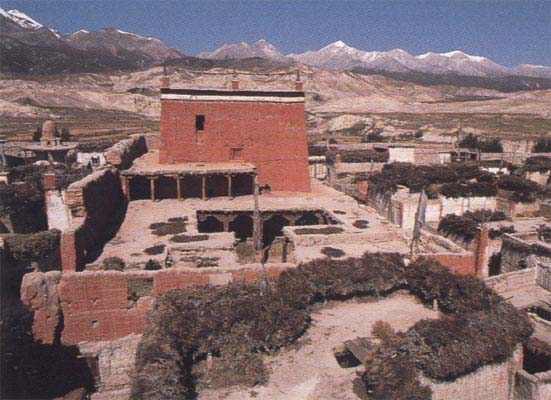
The Byams pa lha khang, and the Thugs chen lha khang, suffered decay during the period of gLo's decline and stagnation under Gorkhali rule, and of their large monastic complexes only a few chapels remain. The Byams pa lha khang today comprises a three floor building fronted by an assembly hall ('du khang) open to the sky at its centre (Fig.1). At the front of the assembly hall a door leads into the circumambulatory passage ('khor sa) that surrounds the ground floor lhakhang. As its name implies the Byams pa lha khang enshrines as its principal object of worship an image of the Forthcoming Buddha Byams pa (Maitreya). This monumental image has its throne set at the front of the ground floor lhakhang and the image at the front of the middle floor lhakhang. Including its throne base it is approximately 50' high. Panjaranath (Gur dgon), the Sa skya protector, is enshrined in the throne base. The walls of the ground floor lhakhang are bare, but the circumambulatory passage contains interesting examples of Tibeto-Newar work. Although there is no epigraphical evidence, these murals were probably painted in the fifteenth century period of the building's foundation - but not by the technically more proficient atelier of the Newar Devananda that painted the mandalas of the middle floor lhakhang. The upper floor lhakhang, accessed by ladder from the assembly hall roof, is painted in a plethora of Tibeto-Newar styles, which most likely also date from the same period.
The middle floor lhakhang is reached from the assembly hall roof. At the front of the lhakhang is the indifferently restored clay image of Maitreya (Byams pa) in padmasana. The mural decoration consists of forty mandalas, approximately four feet in diameter, twenty in a lower and twenty in an upper row, around the walls of the lhakhang, with fourteen(?) smaller mandalas forming an intermediary row. The intervening space is filled with figures of bodhisattvas, lineage lamas and floral motifs. On both sides of the doorway four(?) lokapalas, one above the other, stand guard. The murals are in a good state of preservation. However, due to the exigencies of light and access only the lower row has been photographed. Above courses of vajras and Buddha-deities (approximately four feet above the floor) are verses of homage to the Buddha-deities of the lower row of mandalas. In most cases these verses permit precise identification, although a few on the right side of the lhakhang are illegible .
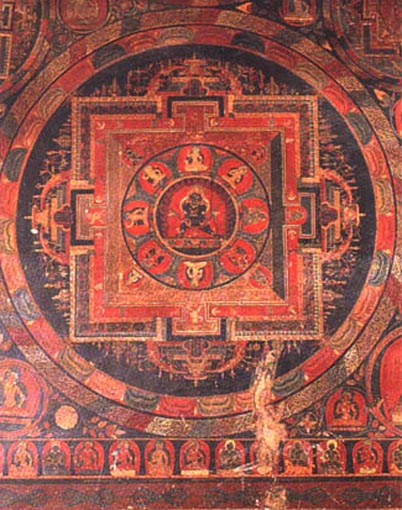
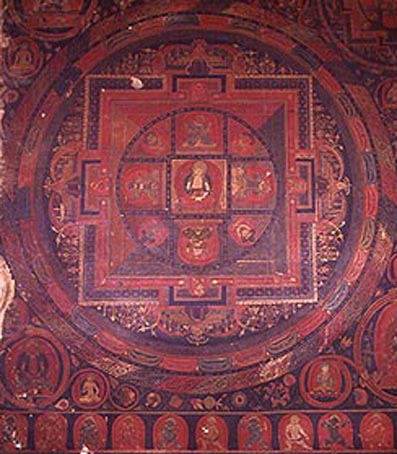
The principal of these mandalas, the Vajradhatumandala (rDo rje dbyings kyi dkyil 'khor) (Fig. 2), known descriptively as the Mandala of the Thousand Buddhas, is located to the left of the Byams pa image that gives the lhakhang its name. The verses beneath it identify it as the Guru Mandala, "the root mandala of the mahayogatantra", and "the basic instructor and trainer in the root tantra". Ngor chen Kun dga' bzang po is identified here as the Lama of this tantric lineage. The root tantra referred to is the Sarvatathagatatattvasamgraha, the seminal tantra that dominated the buddhadharma of the second period of its dissemination in Tibet. In Western Tibet it was propagated by Rin chen bzang po as we see at A lci and rTa bo, and it was one of the main dharmas of the Sa skya School. The significance of this tantra and its Guru Mandala to the systematisers of the Sa skya School - particularly Bu ston Rin po che and Ngor chen Kun dga' bzang po - may be gauged, for example, from its commanding place in the gNas brtan lha khang at Zhwa lu, the dedication to it of a lhakhang in the rGyal rtse gtsug lha khang, and also from the rGyal rtse sku 'bum itself which illustrates the Sarvatathagatatattvasamgrahatantra, and its supplementary explanatory tantras, in the lhakhangs below the harmika (but see also Richardson, 1990, pp.271-275).
It should be noted that available data indicates that the Newars never made systematic collections of tantras nor painted sets of mandalas on their vihara walls. But what is evident from a comparison of Newar mandala paubhas and Sa skya school mandala thankas ("Ngor mandalas") is that the Tibetan mandala style is derived directly from the Newar and that in the period of the Tibeto-Newar school only minor distinctions are evident between them in composition or style. The depiction of Lamas in the upper or lower registers is sometimes the only method of identifying the Tibetan provenance.
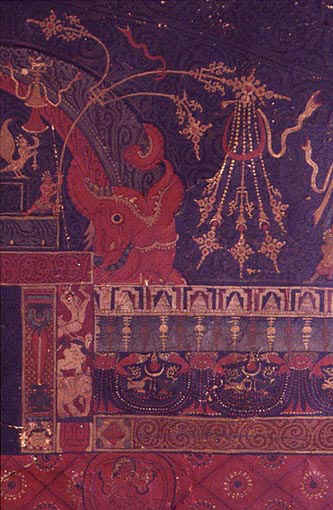
At the centre of the Vajradhatumandala (Fig 3) is the Tathagata Vairocana (rNam par snang mdzad), white, four-faced, in bodhyagrimudra, the mudra of supreme clarity and purity. Vairocana is surrounded in the four directions by subsidiary mandalas of the other four Tathagatas. The square enclosing the Five Tathagatas is surrounded by the thousand Vajrasattvas (rDor sems), representing the ideal visionary form of the Lamas of the lineage . The outer mandala walls represent the line dividing the microcosm, the divine psycho-organism, from the macrocosm, the elemental cosmos. The gates represent the four sense organs of sight, sound, taste and smell and each is guarded by one of the Guardian Kings (Caturmaharaja). In the design of the mandala walls and gates, note the uncluttered composition, the fine line of the detail, and the wall to wall scrolling. The detail of the mandala gate (Fig.4) shows the makara holding in his mouth a spoke of the visvavajra upon which every mandala is laid. Fig.5 shows a detail of a comparable mandala from the rGyal rtse sku 'bum, which can serve to illustrate the development of style within the Tibeto-Newar school.
In the rGyal rtse mandala, the stupas in the upper register of the mandala wall have become piles of jewels; in the register below, the ornaments show a more pronounced Tibetan style; below that the full Newar Kirtimukha motif has been lost; and below that again the style of scrolling has been modified. In the pillars of the gate, the elephant, sardula and kinnara have become totally enclosed in the pillar and the inner pillar is a further example of Tibeto-Newar modification. The makara here has an added touch of realism, as indeed wrathful deities in general increasingly tend to as the style evolves. And finally the brilliant gold scrolling outside the gate replaces the more sombre green.
To the right and below the Vajradhatumandala, Amoghasiddhi and Vajrasattva are exquisitely depicted in unmodified Newar style (Fig.6). These Buddhas are enclosed within the circular stems of the flowers that fill the intermediate space. These flowers are done in an exuberant style that shows the syncretic dynamic at work within the Tibeto-Newar school, particularly in decorative detail. Similar products of such unfettered imagination may be found in the Tibeto-Newar murals of the Tathagatas in the bKa' 'gyur lha khang at Zhwa lu (Vitali, 1990, pls.71 & 72) and in the Yuan-influenced painting in the ground floor circumambulatory passage (Vitali, 1990, pls.58 & 59). Such exuberance was unknown in the Kathmandu Valley in the Early Malla period, when floral motifs, represented here by the rain of small flowers, were naive and simple. The treatment of kinnaras - and particularly of their tails - during that period, on the contrary, was highly sophisticated and can be seen here in the kinnaras on top of the Buddha's thrones.
The majority of mandalas subsidiary to the principal Vajradhatumandala represent Vairocana in his krodha forms, or in his aspect as peaceful Vajrapani (Phyag rdor), in the centre of various emanatory retinues.10 These retinues are often gods and demigods of the Hindu spiritual world, who have been coerced into serving the buddhadharma in their various capacities by the yogin visualizing them as emanations of Vairocana in his heart centre. The mandalas chosen for illustration here, appearing at the back of the lhakhang, are also to be found in two lhakhangs of the rGyal rtse sku 'bum, where they correspond to descriptions in the Durgatiparisodhanatantra, an explanatory tantra of the Tattvasamgrahatantra (see Lo Bue and Ricca, 1993, pp.280-81).
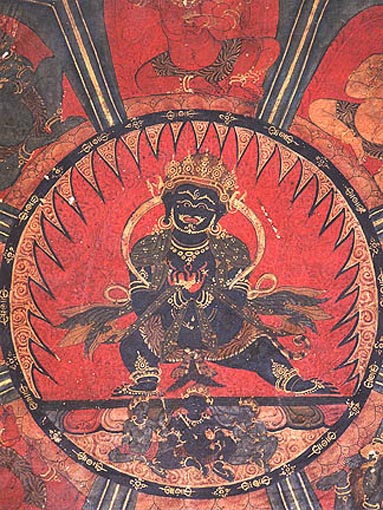
Trailokyavijaya (Khams gsum rnam rgyal), "Victorious Over the Three Worlds", is the krodha of the vajra family, and a principal wrathful aspect of Vairocana. The mandala immediately to the right of the doorway (R-1) shows Trailokyavijaya as the principal, iconographically identical to Vajrahumkara (Fig.7). He is blue-black, two-armed, standing in pratyalidha stance showing vajrahumkaramudra. The execution is very fine, but note the specifically Tibetan elements modifying the Newar. The white stole flying above the deity's shoulders and around his arms is a convention of the Tibeto-Newar school unknown in the Kathmandu Valley until it was introduced from Tibet (see Lo Bue & Ricca, 1993, pp.78-79); the tiger skin around the Buddha-deity's waist has a fantastic stylized design of Tibetan origin - undoubtedly an innovation of artists unfamiliar with tigers; the green silk shawl is another Tibeto-Newar innovation; the flaming aura out of which he steps has the usual Newar scrolling, but the tongues of flame are stylized with an insistent spikiness to be found frequently in the rGyal rtse sku 'bum. Further, note the heavy black outline that also appears around trees and vegetation after the time of Grags pa rgyal mtshan at Zhwa lu, and which is found in the circumambulatory passage on the floor below.
Trailokyavijaya's retinue consists of the Navabhairava ('Jigs 'byed dgu) and their consorts, eight in the surround and the principal Bhairava with his consorts underneath Trailokyavijaya's throne. The nine-fold Bhairava retinue is derived from the saiva tradition, where their consorts, or saktis, are the Navamatrka, the Nine Mother Goddesses. Bhairavas and saktis are here depicted in peaceful mode, but the Bhairavas' residences are usually cremation grounds. Here, then, Trailokyavijaya is seen in his function as transmogrifier of the wrathful forms of Siva perceived as dynamic aspects of the divine ego. Note the angular stylization of the eight lotus petals in which the Bhairavas sit.
Beside the Trailokyavijaya mandala is the mandala of Krodharaja Jvalanala (Khro bo'i rgyal po Me ltar 'bar ba)(R-2), "Blazing like Fire" (Fig.8). One of the principal krodha forms of Vairocana, showing the vajrahumkaramudra, iconographically he is indistinguishable from Vajrahumkara. His retinue consists of the Astamahadeva (Lha chen brgyad) emanated with Jvalanala, as the inscription informs us, from Vairocana's heart. Here again Vairocana emanates his wrathful form to subdue and transform saiva deities into protectors of the Buddha mandala. The Sitaganesa, "White Ganesa", holding an axe and seated upon his vehicle the rat, is executed in fine Newar style (Fig.9): the artist is evidently familiar with the appearance of the elephant and this Ganesa contrasts strongly with the depiction of the more mythic type of elephants found in the Thugs chen lha khang and at Zhwa lu, for example. Note again the angular lotus petal stylization and also the modified scrolling.
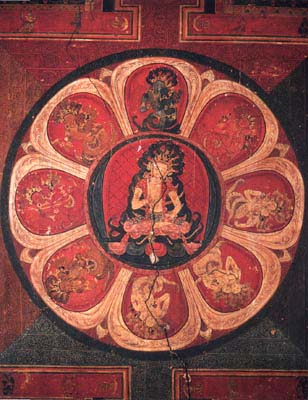
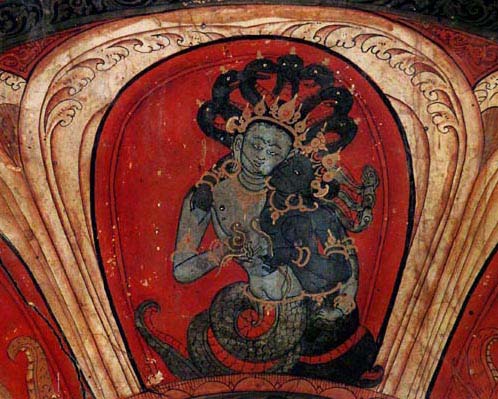
To the left side of the entrance is a very fine mandala of Vajrasattva (rDor sems), Vajrapani in his peaceful aspect (L-1). The identification of Vajrapani and Vajrasattva is a convention of the Durgatiparisodhanatantra. Vajrapani with a canopy of nagas is seated in the centre of his Astamahanaga retinue of naga and nagini couples (Fig.10). The cult of the naga demigods is historically and contemporarily strong in the Himalayas from Kashmir to Assam and especially in the Kathmandu valley where the Eight Nagas are worshipped by both Buddhists and Hindus. In this mandala Vajrasattva controls the nagas as raingivers and protectors of the treasures of the earth. Note the eight petals are here depicted more naturalistically in the Newar style. This mandala, in a very similar style, has been preserved in the Tshe dpag med lha khang at Zhwa lu: but the mandalas of that lhakhang are dated to Bu ston's period there in the 14th century (Vitali, 1990, p.110).
The first mandala on the left, side wall, again shows Vajrapani as Vajrasattva, this time in the centre of his retinue of the Caturmaharaja (rGyal chen bzhi), the Four Guardian Kings (L-4) (Fig.12). Dhrtarastra with lute is in the east (below Vajrasattva), Virudhaka with sword in the south, Virupaksa with stupa in the west, and Vaisravana with victory banner in the north. Here we have an example of a Central Asian or Chinese originated icon, the Caturmaharaja, treated in Tibeto-Newar style. There is no symmetrical four-petalled lotus as the seat of the principal and retinue - rather, vajra walls separate the nine sections. Vajrasattva wears long silks with a geometric pattern similar to his retinue. His lower garment has the Chinese ankle length, hanging in Chinese-style folds. The Kings wear Hats of Victory, Chinese robes over their breastplates and Chinese shoes. This painting shows the innovative creativity of the artists of the Tibeto-Newar school when treating subjects out of their tradition - a quality perhaps better illustrated by their treatment of Panjaranath (Gur dgon), for instance, the Sixteen Arhats or the Mahasiddhas.
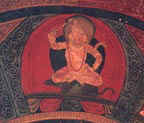
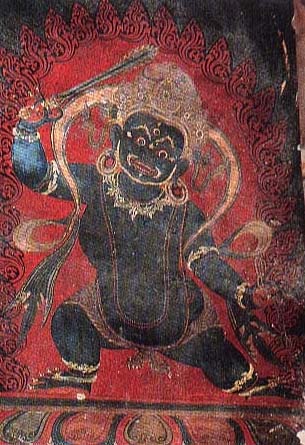
Finally, a glance at the eight lokapalas guarding the doorway: the fine blue protector to the left upon entry is Vajrahumkara, identified in the inscription by implication. To the left upon entry, above the red lokapala, is a blue Protector wielding sword and rope, evidently an aspect of Mahakala (Fig.13). A comparison with a Vajrapani from the rGyal rtse sku 'bum (Fig.14 and Lo Bue & Ricca, 1993, pl.38) shows remarkable similarity. The dwarfish figural proportion and short necks, the hair-knots, and the stylization of the auras' tongues of flame, indicate a unity of style; but at the same time the more decorative blue stole, the snowlion shawl, the Tibetan Garuda between Vajrapani's feet holding the intertwined therianthropic naga couple in his mouth, can serve to show the greater loosening of Newar composition and style at rGyal rtse. Vajrapani's lotus throne on its stalk and the naturalistic floral composition below are a remnant of Pala style.
To conclude, as an example of the Newar penetration of the Tibetan artistic sphere, as a link in the development of the mature Tibetan style that was the basis of the later sman ris school, and as an inspire d rendering of the Tattvasamgrahatantra mandalas by Tibeto-Newar artists, the murals of the middle floor of the Byams pa lha khang are without compare. It is unfortunate at this juncture that political conditions have prevented a more thorough study of the Byams pa lhakhang and a complete photographic record. It is to be devoutly hoped that the fabric of the building be preserved.
1. I use "Tsang" loosely and for convenience throughout this article to define a geographical area, rather than a political entity, including Byang and gLo. [BACK]
2. The verse identifying the master painter is found - in diminutive script - beneath the Vajradhatumandala. His name is given as Bal po Dhe ba Lha dga'. Bal po is his title, "Newar"; Dheba is the Sanskrit or Newari deva; Lha is a Tibetan translation of deva, and dga' is a rendering of ananda. Thus this Newar master's name was probably Devananda. Within the Dasadikpalamandala another inscription immortalizes a Tibetan artist called Chos kyi dbang phyug.[BACK]
3. David Jackson's "The History of Se-rib", 1978, and "The Early History of Lo (Mustang) and Ngari", 1976, provide the best secondary sources of gLo's history to date and I have relied upon them in the following passages. [BACK]
4. rGyal ba'i sku gsung thugs kyi gtsug lag 'di / mthong thos reg pa tsam gyis grol ba dang / phyag sogs bskor ba tsam gyis grol ba dang / yid la bsams pa tsam gyis grol bar shog // 'Di bzhengs [gzhin in Tucci] dge ba rab dkar dri med des / sbyin bdag sku mched sras dang gtsun mor bcas / 'gro kun sgrib sbyangs tshogs gnyis rab rdzogs nas / kun mkhyen rgyal ba'i go pang myur thob shog // These and the following transcriptions were made in 1992. Michael Henss reproduced Prof. Tucci's partial and ill-ordered transcriptions in his Mustang: Tibetisches Koenigreich im hohen Norden Nepals, 1993, pp.160-167, which show slight but unexplained variations. [BACK]
5. Khyad par mnga' ris g-yas ru lho'i stod / dge bcu 'dzom pa'i gnas bde blo'o 'dir / gsang ba'i bdag po'i rnam phrul las byung ba'i / a'i mtshan can yab sras [sku?] mched 'khrungs / gzhan sde nag po'i phyogs rnams pham mdzad cing / rang sde dkar po'i las rnams rgyas mdzod pa'i / stobs chen gang gis sangs rgyas bstan pa ni / 'dam du bying 'dra 'gyen 'degs phyir du / thams cad mkhyen pa phyogs....dang / rdo rje 'dzin pa kun dga' bzang po sog[s] / ...mkhas sgrub.....nas / bstan pa dar shing rgyas pa'i ..mdzod // [BACK]
6. Sangs rgyas phun tshogs, De bzhin gshegs pa thams cad kyi bgrod pa gcig pa'i lam chen gsung ngag rin po che'i bla ma brgyud pa'i rnam thar glegs bam gnyis pa las rDo rje chang Kun dga' bzang po'i rnam par thar pa legs bshad chu bo 'dus pa'i rgya mtsho yon tan yid bzhin nor bu'i 'byung gnas (Lam 'bras bla ma'i rnam thar pp.475-585), publishing data unavailable, see pp.537-540. [BACK]
7. The verses provide the following identifications of the twenty mandalas of the lower row, beginning on the left side of the door upon entry and proceeding clockwise: Left-1 (rear wall) rDor sems (Vajrasattva) with klu chen brgyad (Astamahanaga) retinue; L-2 Rab brjid khro chen Me ltar 'bar ba (Jvalanala) with bza' brgyad (Astagraha) and rgyu skar (Naksatra) retinue; L-3 rDor sems (Vajrasattva) Rigs rnams kun gyi bdag with phyogs skyongs bcu (Dasadikpala) retinue; L-4 (left side wall) Phyag rdor (Vajrapani) with rgyal chen bzhi (Caturmaharaja) retinue; L-5 Don yo[d] grub pa'i las rigs (karmakula of Amoghasiddhi); L-6 sPyan ras gzigs... gyi las rigs (karmakula of Avalokitesvara); L-7 Khams gsum rnam rgyal las rigs (karmakula of Trailokyavijaya); L-8 De bzhin gshegs pa'i las rigs (karmakula of Vairocana); L-9 rTsa rgyu[d] rtsa ba'i Nam snying(?); L-10 (front wall) rTsa rgyu[d] rtsa.ba'i 'gro 'dul (Vajradhatumandala); Right-10 Chos dbyings gsung gi dbang phyug (Dharmadhatuvagisvara); R-9 (right side wall) gSang ldan (gZhon nu) 'Jam pa'i dbyangs (Manjughosa); R-8, R-7, R-6, R-5 are illegible; R-4 Spyan ras gzigs...'Od dpag med pa sems dpa' (Avalokitesvara); R-3 (rear wall) Khams gsum rnam rgyal (Trailokyavijaya) as Mi skyod rdo rje khro bo (Aksobhyavajra); R-2 Khro bo'i rgyal po Me ltar 'bar ba (Mahakrodha Jvalanala) with Lha chen brgyad (Astamahadeva) retinue; R-1 ['Khor los] sgyur 'bar(?) (Cakravartin? = Trailokyavijaya) with 'Jigs 'byed dgu (Navabhairava) retinue. Gang gis khyod sku mthong bar gyur pa'am / khyod gsung lan gcig thos pa tsam gyis kyang / srid zhi'i rgud pa mtha' dag skyob mdzad pa / rtsa rgyu[d] rtsa ba'i 'gro 'dul la phyag 'tshal. // dPal ldan rnal 'byor rgyud chen gyi / rtsa ba'i dkyil 'khor rdo rje dbyings / de yi rgyud pa'i bla ma la / sgo gsum gus pas phyag 'tsal lo // Chos rje kun dga' bzang po la phyag 'tshal lo // "Whoever beholds this [mandala] or whoever even hears its name just once is protected from the troubles of existence: we pay homage to the basic instructor and trainer of the root tantra." "Homage with body, speech, and mind to the Lama of the lineage of the root Vajradhatumandala of the glorious mahayogatantra." "Homage to the Lord of Dharma Kun dga' bzang po." 'Jigs pa'i hung sgra des bsgrogs shing. [BACK]
Francke, A. H., Antiquities of Indian Tibet, Part II, S.Chand, New Delhi, 1926.
Gyatso, Sonam, Tibetan Mandalas: the Ngor Collection, Kodansha, Tokyo, 1983.
Henss, Michael, Mustang: Tibetisches Koenigreich im hohen Norden Nepals, 1993, Fabri Verlag, Ulm, 1993.
Jackson, D.P., "The Early History of Lo (Mustang) and Ngari" 1976, Contributions to Nepalese Studies, Vol 4 no.1, 1976.
------- "The History of Se-rib", Kailash, Vol Vl, no.3., 1978.
Lo Bue, Erberto & Ricca, Franco, The Great Stupa of Gyangtse, Serindia, London, 1993.
------- Gyangtse Revisited, Casa Editrice Le Lettere, Torino, 1990.
Richardson, H.E., "The Cult of Vairocana in Early Tibet," Indo-Tibetan Studies, Tring, 1990.
Vitali, Roberto, Early Temples of Central Tibet, Serindia, London, 1990.
Fig.1. gLo sMon thang and the Byams pa lha khang looking north
Fig.2 The Vajradhatumandala, the principal mandala.
[Fig.3 Detail of the Vajradhatumandala showing the Thousand Vajrasattvas, mandala wall and gate.]
Fig.4 Detail of the Vajradhatumandala showing the makara and gate
[Fig.5 Detail of a rGyal rtse sku 'bum mandala gate]
Fig.6 Amoghasiddhi and Vajrasattva in rondels, with floral motifs
Fig.7 Detail of the Trailokyavijaya mandala showing the Red Bhairava couple above and Mahadeva with consorts below
Fig.8. The Jvalanala mandala with Astamahadeva retinue
Fig.9 Detail of Jvalanala mandala showing Sitaganesa
Fig.10 The Vajrasattva/Vajrapani mandala with Astamahanaga retinue
Fig.11 Detail of Vajrasattva mandala showing naga couple
Fig.12 The Vajrapani mandala with Caturmaharaja retinue
Fig.13 The dharmapala Mahakala, a protector of the doorway
[Fig.14 A Vajrapani from the rGyal rtse sku 'bum.]
Sarva Mangalam!
May all beings be happy!